

How to Change Your Name in Pennsylvania


Pennsylvania is two completely different jobs wearing the same name. Changing your name through a marriage or a divorce here is straightforward and quick. Changing it by court petition, because you are choosing a new name outright, is one of the most demanding processes in the country: two newspaper notices, fingerprints sent to the State Police, and proof from every county you have lived in for five years that nobody has a judgment against you.
Which of those you are doing decides everything. So this page keeps them apart rather than blending them into one vague list.
There is also a deadline most people never hear about. Pennsylvania gives you 15 days to tell PennDOT, and that comes from the Vehicle Code rather than from any leaflet, which is exactly why it goes unnoticed.
This page covers all four routes to a name change in Pennsylvania: marriage, divorce, a court petition, and a child's name change.
Do this first: the Pennsylvania name change order
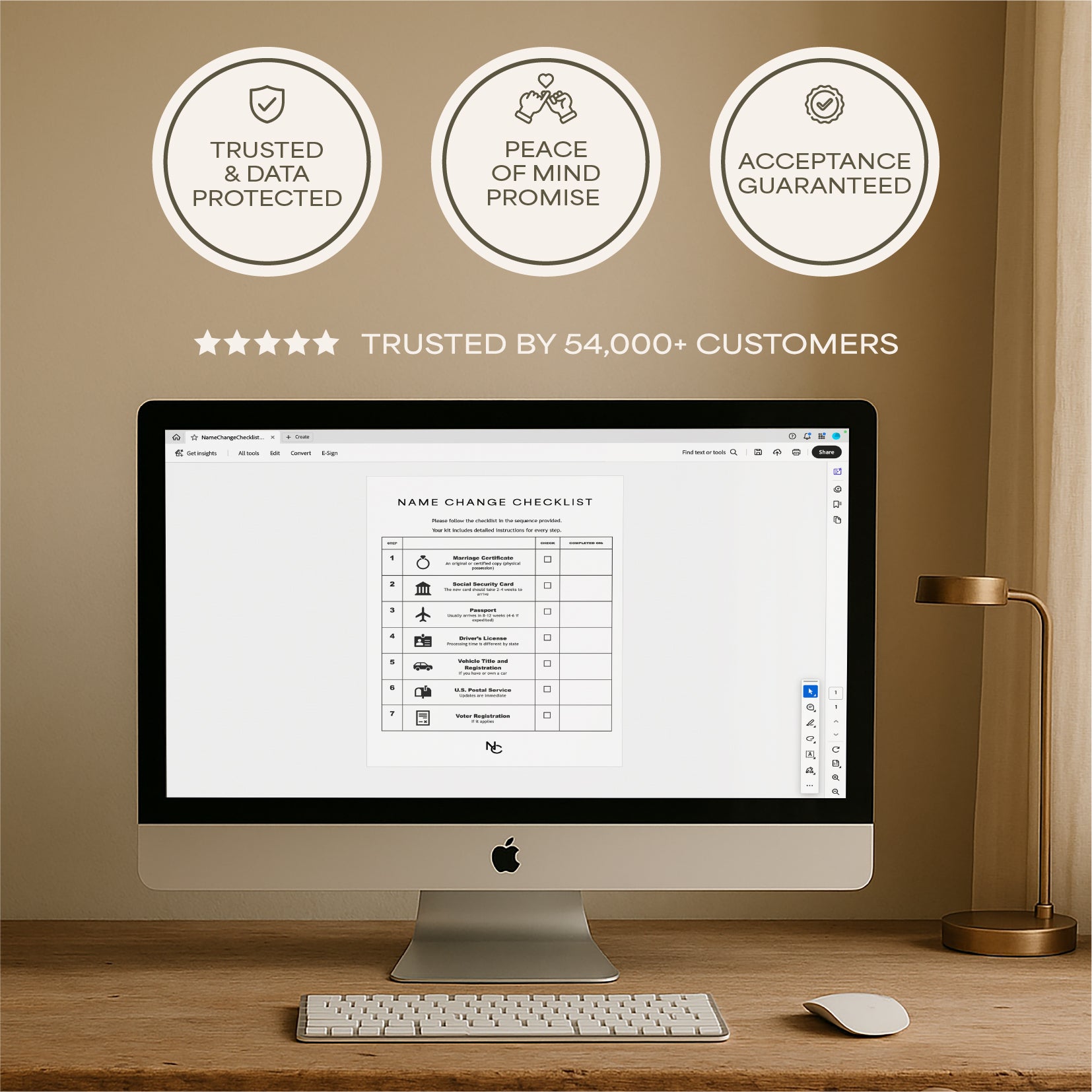
Work top to bottom. Each step is what makes the next one possible:
- Get certified copies of your Pennsylvania marriage certificate, your divorce decree, or your court order.
- Update your Social Security record and let it settle.
- Notify PennDOT and get a new driver's licence, within 15 days.
- Update your vehicle title and registration.
- Update your voter registration, which Pennsylvania lets you do online.
- Update your U.S. passport.
- Clean up the rest: bank, employer, insurance, doctor, subscriptions.
The 15 day rule nobody mentions
Section 1515 of the Pennsylvania Vehicle Code is the source, and it is worth quoting the shape of it because the wording matters.
When a licensee's name changes, that person must notify PennDOT within 15 days of the change, giving the former and new names and the number of the licence they hold. The same section covers a change of address, and it applies even if you have moved out of state. The department has to be notified of a name change in writing.
Two honest notes. First, PennDOT's own service page walks you through the forms without repeating the 15 days, which is why so few people know about it. Second, this is an administrative requirement rather than a criminal one, and Pennsylvania does not publish a penalty for a late name change. Treat it as a schedule, not a threat. The real cost of drifting is the same everywhere: your licence is the ID every other office checks against.
Step 1. Get certified copies of your Pennsylvania marriage certificate
Pennsylvania keeps marriage records at county level and has done since 1885, so there is no state office to write to for this.
Your certificate comes from the Register of Wills, who serves as Clerk of the Orphans' Court, in the county that issued your marriage licence. That is the county where you applied, not necessarily where you live now and not necessarily where the ceremony happened. Marriage licences have been issued by that office at each county courthouse since 30 September 1885.
Now the Pennsylvania trap, and it sends real people home from the counter. For official use, the marriage certificate has to be signed by the register of wills or the clerk of the orphans' court, not only by the officiant or clergyperson. The handsome certificate your minister signed at the ceremony is a keepsake. It is not the certified record, and an agency that knows the difference will refuse it.
Order two or three certified copies while you are asking. Social Security wants one, PennDOT wants one, and a passport application is a third.

Step 2. Update your Social Security card
Federal, so it is the same in Pennsylvania as anywhere, and it still goes second.
You submit an application for a corrected card with your certified proof and your identification. There is no fee, your number does not change, and the new card arrives by mail. Give it a day or two to settle before you queue at a Driver License Center, because a licence application checks your name against that record.
The full walkthrough is here: the Social Security name change, start to finish.
Step 3. Update your Pennsylvania driver's licence
In person, at a Driver License Center, with the form filled in before you arrive.
Which form depends on what you hold, and turning up with the wrong one is a wasted morning:
- DL-80 for a non-commercial driver's licence.
- DL-80CD for a commercial licence.
- DL-31 for a learner's permit.
- DL-54B for a photo ID card.
Bring original documents, not photocopies. For a married name that means your marriage certificate. For a court-ordered change it means a certified copy of the court order. PennDOT also has a route for other name changes that runs on your Social Security card plus two further sources in the new name, such as tax records, a passport, voter registration, a government photo ID, banking records or a baptism certificate.
This is the sensible moment to sort out REAL ID if you have not. You are already at the counter holding certified documents, which is what a REAL ID application wants to see.
Step 4. Update your vehicle title and registration
Separate from your licence, and easy to forget precisely because PennDOT owns both.
Your driver record and your vehicle record are different files. Updating the licence does not rename the title. The vehicle side has its own application for a correction or change of name, form MV-41A, and its own fee.
If your vehicle is financed or leased your lienholder holds the title and has to be part of a title change, so call them before you send anything.

Step 5. Update your voter registration, online
One of the quicker wins, and Pennsylvania handles it well.
Go to the PA Voter Services portal at pavoterservices.pa.gov and complete a voter registration application, ticking the box marked Change of Name. Have your Pennsylvania driver's licence or PennDOT ID card to hand, which is why this belongs after step 3. Without one you can upload a signature instead, or print and sign the form. It takes about ten minutes.
The timing rule worth knowing: a change made more than 15 days before an election takes effect for that election. A change made 15 days or fewer before an election takes effect for the next one. So if a primary is close, do this first rather than last.
When you next vote, bring identification in your new name.
Step 6. Update your U.S. passport
Federal, and worth starting early if you have travel booked.
You send your current passport, your certified proof, a new photo and the correct form. Which form applies depends on how recently your passport was issued, and picking the wrong one is what makes people pay a full renewal fee instead of a cheaper correction.
Changing your name in Pennsylvania after divorce
Pennsylvania gives you a shortcut here that many states do not, and it is the single most useful thing on this page for anyone divorcing.
You do not need a new court case to go back to a former surname. You file a written notice in the office of the prothonotary of the county where the divorce action was filed or where the decree was entered. That notice is the mechanism. No petition, no publication, no fingerprints, none of the machinery described in the next section.
The prothonotary's office is the civil filing office of the Court of Common Pleas. Ask them for the notice to resume a prior surname, file it, and get certified copies, because that filing is what PennDOT and the passport agency will want to see.
If your decree already addresses your name, that decree is your proof and you use it exactly the way a marriage certificate is used above.
The full sequence, including what each agency rejects and why, is in our divorce name change checklist.
Changing your name in Pennsylvania by court petition
This is the route for choosing a new name outright, and Pennsylvania asks for more than almost anywhere else. Read the whole list before you start, because each item takes time to obtain and they run in parallel rather than in sequence.
You petition the Court of Common Pleas in your county. Then:
- A hearing within about a month. The court sets a hearing to be held within one month of the petition being filed, which is faster than people expect and is the reason the rest of this has to move.
- Two newspaper notices. Notice of the filing is published in two newspapers of general circulation in the county where you live, or a contiguous county. One of the two may be the official paper for legal notices.
- Fingerprints to the State Police. The court forwards a duplicate copy of your application and a set of your fingerprints to the Pennsylvania State Police, who check them against criminal history records and certify back to the court what action was taken. They have 60 days from receipt to do it. You pay the cost.
- A judgment search from every county you have lived in. An adult petitioner has to show there are no outstanding judgments against them, proved by a judgment and lien check completed, signed and sealed by the Prothonotary's office, from every county lived in during the five years before filing. If you have moved around, start this first. It is the item most likely to delay you.
Fees and local practice vary by county, so confirm both with your prothonotary before filing. Of all fifty states this is the one where a lawyer earns their money.
Changing a child's name in Pennsylvania
A parent or legal guardian petitions the Court of Common Pleas in the county where the child lives.
Consent decides how this goes. Where both parents agree it is generally straightforward. Where one objects, the court can still grant it, but the question becomes whether the change is in the child's best interest, and that is a contested hearing rather than a formality. If the judge approves, the signed decree is what updates the child's identification, school records and accounts.
Three things that trip people up in Pennsylvania
Bringing the certificate the clergyperson signed. For official use it has to carry the signature of the register of wills or the clerk of the orphans' court. The ceremonial one does not count.
Assuming PennDOT renamed the car. The driver record and the vehicle record are separate. The title needs form MV-41A.
Missing the 15 days. It is in the Vehicle Code rather than on the leaflet, and the notice has to be in writing.
How the kit handles the tedious part
All of the above is doable alone. What it costs you in Pennsylvania specifically is knowing which of four PennDOT forms applies to the card in your wallet, that the vehicle title needs its own one, and which certified copy an agency will actually accept.
Our name change kit gives you the Pennsylvania paperwork already filled in, in the order the offices want it, with stamped envelopes. It covers marriage, divorce and a court order alike. It does not replace the offices, and NameChange does not issue any legal document for you, so the marriage certificate, the decree and the court order still come from Pennsylvania. What the kit removes is the assembly work, so nobody sends you home.
Pennsylvania name change FAQ
How long do I have to change my name on my Pennsylvania driver's licence?
15 days. Section 1515 of the Pennsylvania Vehicle Code requires you to notify PennDOT within 15 days of a name change, in writing, giving your former and new names and your licence number. The same rule covers a change of address.
Where do I get a certified copy of my Pennsylvania marriage certificate?
From the Register of Wills, acting as Clerk of the Orphans' Court, in the county that issued your marriage licence. Pennsylvania has kept these at county level since 1885. For official use the certificate must be signed by the register of wills or the clerk, not only by the officiant.
Which PennDOT form do I need?
DL-80 for a non-commercial driver's licence, DL-80CD for a commercial one, DL-31 for a learner's permit, DL-54B for a photo ID card. Vehicle title and registration use MV-41A instead.
Do I need a court order to go back to my maiden name after a Pennsylvania divorce?
No. You file a written notice with the prothonotary of the county where the divorce was filed or the decree entered. There is no petition, publication or fingerprinting for that route.
Why does a Pennsylvania name change need newspaper notices?
Only the court petition route does. Notice of the filing goes in two newspapers of general circulation in your county, one of which may be the legal notices paper. A name change through marriage or divorce needs no publication at all.
Can I update my Pennsylvania voter registration online?
Yes, at pavoterservices.pa.gov. Complete the voter registration application and tick Change of Name. Have your PennDOT licence or ID handy. Changes made more than 15 days before an election apply to that election.
What does the name change kit actually do?
You get a personalized checklist, your Pennsylvania and federal forms pre-filled, and instructions in the right order. You still sign and submit yourself. See what is in the kit.
The bottom line
A name change in Pennsylvania is easy through a marriage and easy through a divorce, where a single notice to the prothonotary does it. By court petition it is one of the hardest in the country, so know which one you are on before you begin. Certified copies from the Register of Wills, Social Security, PennDOT within 15 days on the right form, then the vehicle title, then voter registration online. If you would rather not work out which form belongs to which counter, the name change kit does that part.
Changing your name in another state?
The order holds everywhere, the offices do not. See Ohio, New Jersey, and Maryland, or browse all fifty on our name change by state directory.

Ready to Change Your Name with NameChange?
Your kit includes everything you need: personalized checklists, pre-filled forms, and step-by-step instructions tailored to your state and situation.
Get Started