

How to Change Your Name in Connecticut


You just got married in Connecticut, and now there is a name to change on what feels like a hundred accounts. Here is the short version: get certified copies of your marriage certificate first, update Social Security next, then your Connecticut driver's license, and let everything else follow from there. Order matters, because most offices want to see your new Social Security record or your updated ID before they will change their own files.
This guide walks you through it in the order that actually works, so you are not redoing steps or waiting on the wrong office.
Do this first: the Connecticut name change order
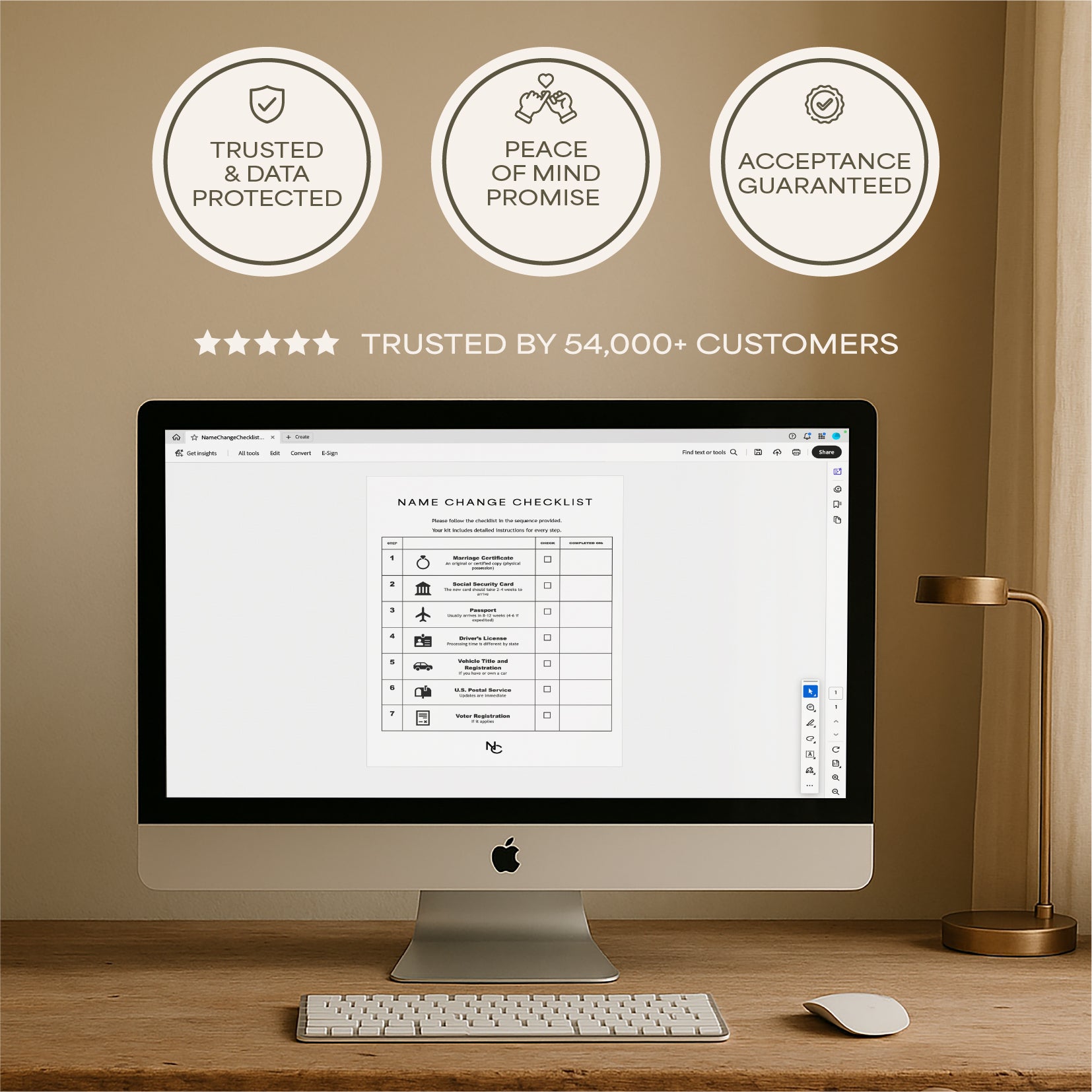
Work through it top to bottom and you will not get stuck:
- Get certified copies of your Connecticut marriage certificate.
- Update your Social Security card.
- Update your Connecticut driver's license or Real ID at the DMV.
- Register to vote under your new name.
- Update your vehicle title and registration.
- Update your U.S. passport.
After those, the rest is cleanup: bank, employer, insurance, doctor, subscriptions. None of them are hard once your Social Security card and license already show your married name.
Step 1. Get certified copies of your Connecticut marriage certificate
This is your proof for every other office, so start here. A certified copy comes from the town or city clerk in the Connecticut town where you were married, not a photocopy of your wedding keepsake certificate. Order at least two or three copies. Social Security, the DMV, and your passport application can all ask to see one, and having spares means you are not waiting on a reorder in the middle of everything.
Fees and processing times vary by county, so check the issuing office's website for the current cost before you order.
Step 2. Update your Social Security card
Social Security comes before the DMV for a reason: Connecticut's DMV and many other offices check your name against Social Security records. Update it here first and the later steps go smoothly. You file an application for a corrected card, show your certified marriage certificate and proof of identity, and your new card arrives by mail. There is no fee, and your Social Security number never changes, only the name on it.


Step 3. Update your Connecticut driver's license or Real ID at the DMV
Once Social Security shows your married name, update your license with the Connecticut Department of Motor Vehicles (DMV). You will need your certified marriage certificate as proof of the name change, and you will get a new license or ID with your married name on it. If you are getting or renewing a Real ID at the same time, bring the full document set they ask for, since Real ID has stricter proof-of-identity rules than a standard license.
Book an appointment ahead of time if you can. Walk-in waits at the DMV can eat a whole morning.
Step 4. Register to vote under your new name
Your voter registration should match your new name and, if you moved after the wedding, your new address. In Connecticut you can update it online through the Secretary of the State, or it often comes up while you handle your license at the DMV. It takes a few minutes and it keeps your ballot and your ID in agreement.


Step 5. Update your vehicle title and registration
Your car's title and registration should carry your married name too. In Connecticut this runs through the DMV, and you can usually handle it around the same time as your license. Bring your certified marriage certificate as proof. If your car is financed or leased, your lender or leasing company may need to sign off on a title change, so check with them before you file.
Step 6. Update your U.S. passport
If you have a passport, update it so it matches your new license and travel bookings. You send in your current passport, your certified marriage certificate, a new passport photo, and the right form for your situation. If your passport was issued recently, you may qualify for a lower-cost update, so check which form applies before you pay the full renewal fee. Traveling soon? Do this early, since passport processing runs on its own timeline.
How the kit handles the tedious part
Every step above is doable on your own. The catch is the busywork: figuring out the right order, tracking down each form, filling in the same details over and over, and knowing which office wants which proof. That is what our name change kit takes off your plate. You tell us your state and your situation, and you get a personalized checklist, the correct pre-filled forms, and plain step-by-step instructions, so you are not stitching together answers from a dozen government pages.
It does not replace the offices, and NameChange does not issue any legal document for you. What it does is get your paperwork ready and in the right order, so each office says yes the first time.
Connecticut name change FAQ
What do I change first in Connecticut?
Certified copies of your marriage certificate, then your Social Security card. Almost everything else, including the Connecticut DMV, checks your name against Social Security, so updating it early keeps the later steps from bouncing back.
Do I need a court order to change my name after marriage in Connecticut?
No. Taking your spouse's name through marriage is handled with your marriage certificate as proof. A court order is only for name changes that are not tied to marriage, like choosing a brand new name.
How long does the whole process take?
The active work is a few hours spread across a couple of weeks, mostly waiting on cards and documents to arrive by mail. Your passport runs on its own timeline, so start that one early if you have a trip coming up.
Can I do any of this online?
Some of it. Depending on your situation, voter registration and parts of the DMV and passport process can have online steps. Others still want your certified marriage certificate in person or by mail. The kit tells you which is which for your situation.
What does the name change kit actually do?
It gives you a personalized checklist, the pre-filled forms for your state and situation, and clear instructions in the right order. You still submit to each office yourself, but you are not guessing what they need. See what is in the kit.
The bottom line
Changing your name in Connecticut is not complicated once you follow the order: marriage certificate, Social Security, license, then everything else. Do it in sequence and no office sends you back to the start. If you would rather not manage the paperwork yourself, the name change kit handles the tedious part for you.
Changing your name in another state?
The order is similar everywhere, but the offices and details differ. See our guides for New York, New Jersey, and Massachusetts.

Ready to Change Your Name with NameChange?
Your kit includes everything you need: personalized checklists, pre-filled forms, and step-by-step instructions tailored to your state and situation.
Get Started